Friday, 7 October 2016

Passage from Durban to East London

Find the whale!
We were on the club pontoon, however most boats were on mooring balls in the Buffalo River
View of yacht club, moored boats, and Maggie at the head of the pontoon.
Hard to see, but the parking lot in the right rear has C Class Mercedes Benz cars waiting to be shipped to the US


Passage from Durban to East London, 260nm

Oct.7, 2016

Monday at sunset, our three boats left Durban Marina. As we were untying a squall was brewing to hit us. We waited for the worst of the gust front to pass over, and then exited. But the squall itself carried on for hours. Shortly after leaving we heard that the harbour entrance was closed due to 7meter waves in the entrance channel. At least we got underway. In the first few hours we were only going about 2 kn with the engine revved up into the seas and wind. It was the first time in a while that we were feeling a bit seasick. Made  only 36nm in the first 12 hours. After that, things calmed down and the wind turned to the NE for a downwind run. We were also in the Agulhas current that gave us an extra 1 to 5 knots speed. With a wind eventually up to 30 kn pushing us, we were going 8 to 10 knots.

The strong NE and falling barometer indicated a strong SW coming soon. Also, we have internet weather sites and Will, our weather router,  telling us the same thing. The other two boats thought they could make it to the Port Elizabeth, before it changed. They arrived Wed in the evening. Tahawas had a very slow last couple of hours beating. We decided to stop in East London instead and arrived midday Wed. We were happy to get 2 good nights' sleep before heading out again. We are leaving after supper tonight, Fri, to get to PE sometime tomorrow. It is about 130nm. The weather still isn't ideal, but we are giving up on that.

One of the really exciting things on the trip were several sightings of whales. I had never seen one jumping right out of the water. The other boats saw them as well so there must be several pods about.

There is a visitor dock here at the Buffalo River Yacht club. But there is only room for one boat. It was tight getting to it through all the mooring lines for the boats on buoys. There are lines attached in rows parallel to the river bank with boats tied bow and stern.
The club isn't officially open for the season yet. But there is someone to pay, and showers available. Nothing interesting within walking distance that is considered safe. On Thurs we took a cab to a mall and did some browsing. It had a grocery store and place to top up the phones . Because there is a casino, hotel, and movie theatre we had no trouble finding a restaurant for dinner.

The primary industry here is a Mercedes Benz factory. The entrance is next to the marina where the cars are loaded onto car carrying freighters.

We are following the news of hurricane, Matthew, and its trail of damage. It will hit Florida today. Good luck to those of you living there, and/or having your boat there.

Happy Thanksgiving this weekend to our Canadian friends and family!

Monday, 3 October 2016

Impressions and things I have learned about South Africa so far

Aids/HIV exhibit in museum

Aids/HIV exhibit in Museum
Egyptian goose on boat in marina


Impressions and things I have learned about South Africa so far

Sept 30, 2016

Despite travel agents suggesting that SA is not safe for travel, we have not felt threatened anywhere. On the road, most people give a friendly wave or want a photo. And the people we have met so far have all been friendly and helpful. Downtown Durban is a poor black area, so we are just being cautious about going out alone or after dark.

Spring is just beginning, with a few trees out in flower, particularly the purple ones. It will be a gardener's delight in a few weeks.

The current drought, 3 years now, has been particularly severe. El Nino last year made it worse. We have seen dead cattle along the side of the road that didn't have enough water. Some ranchers have to cull their herds. Sometimes the water is shut right off and they deliver containers of water to use. In the marina the water is on only certain hours of the day. The SW gales this month have been much stronger and colder than usual.

30 % of the population have HIV or Aids. (perhaps just the black %?) This is having a huge effect on the country. The medical system is strained. Businesses that rely on migrant labour like farming, cutting sugar cane and mining are losing much of their work force. At  Ardmore ceramics they have photos of the many artists they have lost to aids. You can see the fresh graves in so many towns.  But things are changing. At that business they have done their own education and the deaths have stopped. With a willingness to admit the problem, the education needed can get done.

25% of the population is unemployed, but that rises to 50% for those under 30. This seems to be a worldwide trend. Another world trend is the migration from a rural to urban lifestyle. It takes awhile to get through the checkout at the local grocery store as people try to use their combination of food stamps, credits and cash, sometimes having to return items to the shelves. The 80% black population own 14% of the land. Mandela's legacy is that there has not been much retaliation after apartheid. They don't want a Zimbabwe. There are quite a few refugees in the country from Zimbabwe. Also, a good number of former white Rhodesians live here waiting for better conditions there.

Poaching is still a major problem. There are news items about it regularly. Rhino horn is prized in China and the animals are stolen even from the game reserves. They have sent 80 rhinos to Australia just in case something happens to them here. They are experimenting with dehorning them to protect the species.

Mandela was a man willing to admit mistakes. He was disappointed that leaders that came after him didn't share his moral values. He removed fences between neighbouring countries to allow animals a larger range. But this has increased poaching from other countries. He increased the number of provinces from 4 to 9. This has greatly increased administration costs. Money was transferred from security to education. Most people think crime has increased since apartheid ended with a weaker police force. This week university students are protesting increased fees. They would like the education to be free, but the country can't afford that. There is much work still to be done here.

There are 2-3,000 human deaths from hippos every year!

The Natural History Museum is doing a good job educating visitors about climate change. It has a "Green Heroes" program. One of the parts of that are stories about the things that staff members do in their personal lives to lessen their impact. The museum and art gallery were free.

We have been here 2 weeks now and are enjoying every minute!


Back in Durban

Zulu dancers

Zulu dancaers

Posing with shaman and apprentice

Zulu valley

Old Post Office
Old Train Station

Exhibit in Durban Museum of Nature

Back in Durban

Sept 29, 2016

Back in town, we have dived into boat repairs. There was a possibility of a weather window tomorrow, Fri for the week's trip to Cape Town. The backstay and bimini repairs couldn't be done in that time frame so we decided to just do a quick repair to last us to Cape Town and repair them better there. The new batteries for the bow thruster arrived and are installed and working. Rob has been busy rebedding deck fittings and hope that makes an improvement on the leaks. He has checked all the wiring on the bilge pump and they seem ok. That means that the pump itself need replacing.

We are not in such a rush now that the weather router has said that we shouldn't leave until late Mon or Tues. Chris on Tom Tom decided to leave today anyway. It is amazing how quickly the weather changes here, and the forecasts as well. When the wind is from the south it is cold,windy, and wet. Yesterday we closed everything up to stay warm enough and mostly stayed aboard. Today, with a NE wind we are back to shorts and tee shirts.

On Tues we had a 13th birthday party for Mirko, one of the Tahawas boys. The marina had a braai (BBQ)  for us and we each made extra food. On Mon, Nora, Klaudia, and I took a taxi to a bakery to order 2 cakes.  We have been using Uber to travel around town. It has been very simple and costs no more that a few dollars per trip. We also stopped at the market, which is mostly Indian here, and at the African Art Centre. At the art centre there are classes for crafters and things for sale.

Today, Thursday, Greg came back to take us to the Zulu dancing that we missed on the Sat tour of Durban area. It was raining so hard that day we bailed out early. We drove back 60 km to the Valley of a Thousand Hills. There is a tourist site there where they have built a traditional Zulu village. They do some traditional dances and songs for you as well as a tour and explanation of the village life. The setting was spectacular, looking out over the hills so it was well worth waiting for a clear day. On the premises there is a reptile land with a good collection of snakes and crocodiles. A guide took us through that. There are many very dangerous snakes in the country. We drove back through the valley and west suburbs into Durban. These towns are all traditional Zulu. There is a dam in the bottom of the valley that regulates the water supply for Durban between the wet and dry seasons. It is getting dangerously low, less than 50%.  Back in the city we picked up Greg's wife and daughter and the three of them came to the marina to visit our boats. If we have time we would like to use him again to see some of the areas around Cape Town.

Yesterday, a reporter visited us. He is going to do an article on our trip and the BPO. He normally takes the photos for the local yacht clubs' events among other things. We'll know more details after he sends us a copy to proofread.

If we have time we could visit the tourist areas along the Golden Mile, the east coast beaches and hotels. There are amusement parks, casino, craft markets, galleries, museums and the like. Not usually our first choice. But we would like to see the old railway station that is now the tourist information centre. When the station was built, the architect's plans accidentally got switched for the railway station in Toronto. The Toronto plans had a roof that could withstand 16 ft of snow. With the first heavy snowfall in Toronto the roof there collapsed, but, of course, the one here has been doing fine.

Oct.3 Addition

On Sat, we went to see the train station, post office, and city hall. These are classic, old colonial buildings. Parts have been renovated for other uses. In the city hall, there is an art gallery and the Durban Natural History Museum. The gallery had a photo exhibition on Aids in 9 different cities with good info and inspiration.
The museum was fascinating. It covered animals, insects, birds, dinosaurs, land and oceans. There was a theme on climate change as well, in particular, what individuals can do.
The wind and rain were terrible Sunday with another low pressure system. Rob spent the whole day installing a different bilge pump, a frustrating experience. The forecasts seem to be getting worse, instead of better, as spring arrives.
Change of plans! We are going to leave after supper tonight, Mon. The weather isn't great but we hope that there is enough time to get the 260nm to East London by Wed night before the next front starts. At least from there we don't need such a long window to sail to Port Elizabeth.


Monday, 26 September 2016

KwaZulu-Natal Tour Days 5 and 6

Museum at site where Mandela was captured before being sent to prison

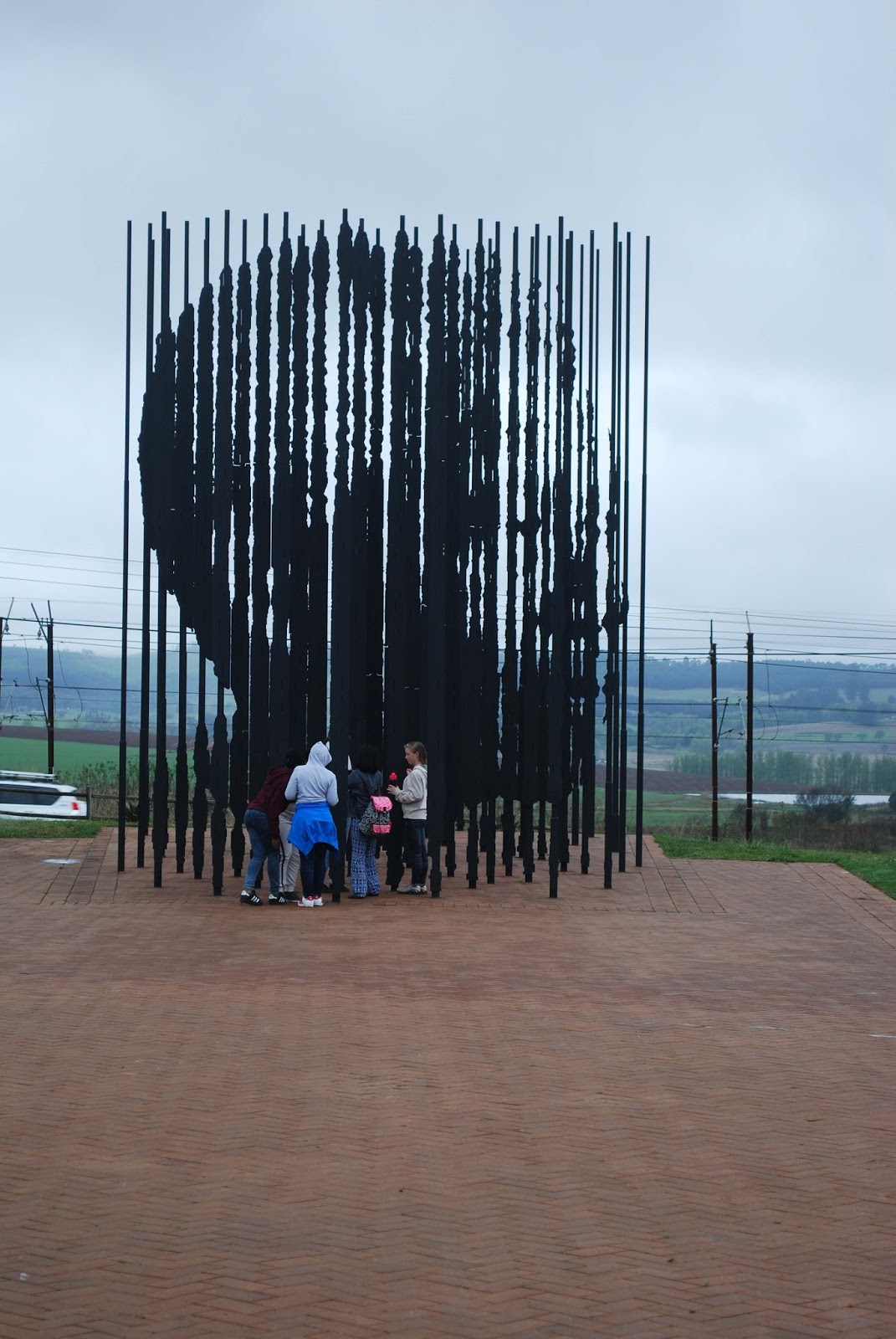
Interesting sculpture - individual vertical rods that show Mandelas' face when viewed at the right angle

Installing a thatched roof

Our accommodation at Giant's Castle resort

View of the resort from the trail leading to the Bushman Caves

Bushman cave drqwings


Incredible scenery


Ardmore Ceramics Gallery - plates showing gallery artists who have died of HIV/A|ids - 30% of the black South African population has HIV/Aids

Examples of Ardmore ceramic art


Howick Falls - 95 metres high

Heritage Day costumes


KwaZulu-Natal Tour  Days 5 and 6

Sept 25, 2016

Friday morning we drove to the site where Nelson Mandela was captured along the side of the road. People wanted to build a large monument there, but Mandela would only allow a simple memorial. Across the street there is a museum documenting his life, work, and much of the apartheid history with lots of photos. It is very moving. Like Gandhi, he grew as a person through his tough years. I'd like to read his autobiography now. They are in the process of building a larger museum on the site.

In the afternoon we continued driving higher into the mountains. We slept our last night at a lodge in another game park. This one is a world heritage site. The reason is a collection of old rock paintings in open caves. We hiked into the site in the morning and a guide introduced us to the art and its possible meanings. They have been done by the original natives called the San or Bushmen. Their skin is more yellow with slightly oriental eyes. There are not many of them left in Africa now, unfortunately. Scientists think that the first homo sapiens originated in this area.

The temperature dropped again to around freezing overnight. It was a beautiful, quiet location with many alpine plants and birds. And the staff fed us well despite no towns in the vicinity. Other guests were there to do extensive hiking.

On the drive back to Durban we stopped at Ardmore Ceramics, a well known company making ceramics using local artists. We were allowed to watch them at work and take photos. There are figures of African animals on most pieces.  The work was beautiful, unique, and expensive. We stopped for a late lunch at a waterfall in Howick that is as high as Victoria Falls but much less water. It was a national holiday, Heritage Day. We got a chance to see some people dressed up for the occasion.

Arrived back in Durban Sat evening. Today, Sunday, we are unpacking, doing laundry and repairs. The inside of the boat was draped in wet and salty clothes as it never stopped raining last weekend. Now we are waiting for good weather to sail to Cape Town. Ideally we would like it nice for a week and go straight there. Otherwise we will start travelling and stop at the few possible places for shelter. This next section is called "The Wild Coast".

KwaZulu-Natal Tour - Days 3 and 4

Former hospital site where the British held off the Zulus in the Battle of Rorke's Drift

Vast valleys of Northern Zululand

Impressive landscapes


KwaZulu-Natal Tour - Days 3 and 4

Sept 21 and 22, 2016

Got started at 7:30 this morning. Drove out of Hluhluwe Game Park into Imfolozi Game Park. This park has mostly wilderness areas. You can visit on a 4 day hike with a guide and donkeys to carry your supplies and food.  It took us longer to get through than we planned as we saw African cape buffalo, giraffes, rhinos, elephants, impalas, nyalas, and even a turtle. What an amazing array of animals, and what a way to see them - in their own environment rather than in a zoo!

 After that it was a full days' drive to Dundee, a town in the coal mining area. In this northern part of the province, many of the major battles between the British, the Zulus, and the Boers for control of SA in the 19th century took place. We stayed in the Royal Country Inn which is filled with war and history memorabilia. The area is called "Battlefields". The scenery reminded us of western Alberta, with dry, rolling hills. The locals in their shacks and shanty towns have only a subsistence living, doing migrant farm work or working in the mines. Coal and other minerals are the main products.

Thursday morning we headed out to one of the battle sites, Rorke's Drift. In the early 1800's, King Shaka, a great Zulu warrior, conquered many of the neighbouring tribes to create a very large powerful nation. They were better trained warriors than many other African tribes. They surprised both the Boers and the British troops with defeats with much loss of life. The British would have been content to have a port at the Cape until diamonds were discovered. Then they wanted more control. The battle at Rorke's Drift was in 1879. 100 British troops held off 4000 Zulus. The 11 survivors received Victorian Crosses. There is now a museum there. Greg, our guide, knows a wealth of information about all this history. The movie, Zulu, is about this particular battle. The Boer War, in 1899, was essentially for control of newly discovered gold. If interested, there has been a lot written about this period.

We spent the afternoon driving further towards the Drakensberg Mountains. We stayed at a beautiful resort in the "midlands", called Rawdons. The temperature kept dropping and the fog was rolling in. It was 13C when we arrived. There was a microbrewery on site, so we enjoyed trying their samples. The only one not drinkable for me was "cappuccino" flavoured beer. With more moisture, this area was favoured by colonists for agriculture and cattle. It seems very British and much more prosperous.


Thursday, 22 September 2016

KwaZulu N\atal Tour - Day 2

Our accommodation at Hilltop Camp

Amazaing views of the park

Hilltop Camp Reception

African Fish Eagle

White backed vultures

Baboons


Rob with Cheetah

Ugundi cow - prized for its hide

Warthog


KwaZulu N\atal Tour - Day 2

September 20, 2016

We were up early for a 8:30am departure to the Endomini Cheetah Centre which was located outside the game park. On the 15 km trip to the park gate we saw white backed vultures partaking in what must have been a kill the during the night, a lion, buffalo, zebras, baboons, impalas, warthogs, and white rhinos as well as a brown snake eagle.

As there are only a few leopards in the game park we are unlikely to see one, and the cheetah is rather elusive there as well. The Cheetah Centre takes care of Cheetahs who were injured and abandoned by owners who had them as pets. They are careful to keep the cheetahs wild and not try to domesticate them. It was surprising to see the difference in size from the smallest strain which looked like a large house cat, to the larger, more powerful, strain that one sees on TV. The cheetah  eats mainly small animals so is not a major predator for big game. It  is itself hunted by other large cats such as the lion and leopard. We found it interesting that the cheetahs can be kept in a quite low fenced area as they don't have the muscle strength to pull themselves up the fence to the top. At the same time they can run at a speed ot 120 kms/hr and can go from 0 to 60 mph in 3 seconds! We were able to enter the cages of some of the cheetah and pet then carefully, under the watchful eyes of two rangers.

In the afternoon we went back to the park and took another three hour tour with our guide, Welcome. We were pleased to see giraffes as well as an elephant up close. Again we saw many buffalo, rhinos, impalas, nyalas and warthogs.

We had another great buffet dinner at the Hilltop Camp and called it a night early as we have an early start in the morning.