Thursday, 12 March 2015

Galapagos to Marqueses Days 1 and 2

Bob with his latest catch - a tuna

Bob's birthday - banana cake!
As expected, we are having a slow, gentle start to the 3000 nm ahead. The area surrounding the islands is still in the ITCZ zone with light and variable winds. We sailed with the spinnaker the first 12 hours but then motored 1am to 12pm Wed. We've  managed some slow sailing from then and overnight. We're back motoring today trying to get further south where the SE trades kick in. We covered 122nm the first day and only 97 the second. We have started to download weather grib files from SSB which are quite useful. If we can get to 4 degrees south and 94 west we should be able sail, hopefully for overnight tonight. The trades really settle in by 5 south. The Marqueses are at 9 S.

Last evening we caught another tuna some of which we are looking forward to eating tonight. Around the same time we and other boats in our vicinity received a distress call on VHF. After checking the boat MMSI number we realized it was Maggie. Still don't know what caused that false alarm as we were busy listening to the evening net check in at the time. Also the AIS stopped working yesterday. There is a warning system display but it is behind our working navigation panel which involves removing a dozen screws-hasn't happened yet today. Between the net and the email with boat positions we know where our fleet is. There is not a lot of other traffic about.

Today is Bob's birthday. He made his own cake-a banana bread with all the over ripe bananas we have. (We purchased a whole stalk for $15) The tuna will make a fine dinner.

Tuesday, 10 March 2015

Goodbye to the Galapagos


Goodbye to the Galapagos

March 10, 2015

The last couple of days has been busy with topping up with fuel and water, and sitting in a very slow internet cafe trying to update our blogs with pictures. Yesterday we took a walk to the Darwin Institute to get our log books signed by officials of the Galapagos National Park and to see the giant saddleback turtles and land iguanas. Pictures will follow! Last evening we had our skipper's meeting in anticipation of our noon departure for the Marquesas today. We've enjoyed our visit to three of the islands of the Galapagos, and are excited about starting the three week or so passage across the Pacific. So far it looks like little wind for the first couple of days. The plan is to head southwest until we reach the area of stronger winds and good current, around 5 degrees south. Hopefully we won't have to motor too much.

Sunday, 8 March 2015

Isabela Island

Blooming cactus

A good catch by local fishermen

Flamingos


March 8, 2015

Isabela Island

Yesterday 15 of us took a day trip to another island, Isabella. It was about 40 nm away and in a speed boat took about 2 hours. When we leave on Tues it will probably take us ..
about 8  hours to cover the same distance again. At 20 kph in a small boat it was a very bumpy ride. Alarms were set for 5 am for an early start.

It was worth the trip as each island has its own unique features and flora and fauna. Isabella is the largest and youngest. There are a number of volcanoes on the island and the last eruption was only a few years ago. The second largest crater in the world is here, 11 by 9 km. A trip to see it wouldn't fit in a one day tour, however. The jeep did take us near 2 high points where we climbed to get a panoramic view. It looks like Arizona with the cactus and lava rocks. Some sailors stayed for a few days if they had crew to mind the boat at anchor.

There are a few remnants of the US presence during the Second World War. Nearby are remnants of an old, infamous, Equadorian penal colony from 1949 to 1956,  the Wall of Tears. As punishment the harsh guards ordered the building of a tall rock wall that caused many deaths and was never finished or needed.

We saw some pink flamingos on one of the lagoons, and took a hike through a mangrove swamp. Where that trail came out on the beach,  there were a number of local fishermen standing in the water dragging a large net across the rock strewn waters. When they pulled it up near us it was full of various types and ages of fish including puffers.  It was fun to watch as the encircling birds waited to get their share. If a fisherman threw a small fish back a bird would likely catch it before it hit the water.

After lunch we did some snorkeling in a spot where the penquins were known to be. You could watch them swimming and catching fish. They prefer cooler weather than it is now so there were not as many out. They are the most vulnerable species to a warming of the water which occurs with an El Nino year. There was a 60% chance of that this year but doesn't look like it is going to happen. That is good news for marine life which drops off with the heat. Also good luck for sailors as the wind is less favourable for sailing west as well as stormier.


School Contacts


March 5, 2015

School contacts

As part of the BPO mission we have been trying to make some contacts with schools and students both here and at home. The challenge has been that this is summer vacation for the students. In the Galapagos they are off for the 3 months of Feb, March, and April. Eduardo, with the National Park, has facilitated a number of interesting contacts.  On Fri am there was a Skype call with a school in Pennsylvania that Tim on No Regrets arranged. The students there have been following our progress and had a chance to ask questions. In the afternoon a group of us visited 2 schools and met with administration and some teachers. Today some students are visiting a couple of sailboats to see what they are like and ask questions. Emails have been exchanged with staff for ongoing contact. Internet service is relatively poor and expensive on the islands so wifi sites generally are not used by the schools.

I'll share some of the ideas presented to us. The first school visited was a private one from preschool to Gr 12, Colegio National Galapagos. It was started by the Scalesia Foundation to support the concepts of sustainability and conservation. The school is built in the woods in the highlands and looks like you are at a camp predominantly living outdoors. Looks very appealing! There are a number of teachers from other countries. It has an English immersion curriculum as well. It has been given Unesco support for promoting peace and preservation.
The other school visited was a local high school which also gets some funding for their programs on the environment. With 800 students there is a bigger variety of programming. They have started an IB program. There are also studies of the local culture, cuisine, music, dress that are required. English is the second language studied.

When the Galapagos was first designated as a World Heritage Site there was some resistance from the older generation because it puts restrictions on what they can do. The school students have contributed a lot toward changing that reaction with marches, displays, and general support. As in many places in the world there is a conflict between conservation and tourism dollars.

As teachers and parents elsewhere, they would like to see children spending more time on outdoor activities. Ironically, the kids here do not have much contact with the sea. They don' t normally swim, sail, snorkel or visit other islands as only the tourists can afford it. Any personal contact with people from other places is considered a good learning experience.

Friday, 6 March 2015

Santa Cruz

Floor of lava tunnel

Giant Tortoise hissing at us!

Entering lava tunnel


March 6 2015

Santa Cruz


 This island is the main tourist area with the airport. The shops are more plentiful and more expensive. Again there are water taxis to take you to and from the boat. All the crew members are enjoying some independence. There are also a number of crew changes being made here as there is relatively good flight coverage. (It is going to be a 36 hour trip for Barb.) Some are flying home to see family or take care of business. Others are joining to help with the next 3 week passage. Another boat, Libby, has joined the fleet from California. The captain, Terry, was originally from Toronto.

On Thurs we did a bus tour of the highlands. This is a newer volcanic island and we travelled to the highest point for a wonderful view of it and many of the surrounding islands. We hiked through a lava tunnel which was interesting, as well as dark, wet and long. We visited a coffee and cane sugar farm that showed the traditional methods and sold organic coffee and some pretty rough rum.
The giant tortoises were living in the area around where we stopped for lunch and it was easy to enjoy seeing many of them.

In the evening most got together to celebrate Jesse’s (on Om) birthday. There has been no lack of chances to visit, drink and eat ashore.

There is a large Darwin research station here as well as another turtle breeding centre. There is a lot of work being done to remove introduced and invasive plants and animals and keep the unique ones alive. We have made a short visit but will return. This am they helped arrange a skype session between them and some schools back home. The Shanks’ daughter’s classroom is one of those participating. Rob and I are awaiting a much needed fuel barge. There is a school visit this afternoon that I will attend. We are here on a tourist visa and found out that it does not allow you to do any volunteering which is a different visa.

On Sat we are taking a 2 hour hired boat trip to Isabela Island where you can see the penquins and flamingos. I’m just listening to a weather warning about high winds for the next few days. Hope our anchor is well set for leaving the boat. It would be great to have the wind stay for the days starting the 10th when we leave. We are starting on those plans.


Remaining Days in San Cristobal

Kicker Rock Channel 

Kicker Rock


 March 4, 2015

Remaining days on San Cristobal


The trip to Kicker Rock was a highlight for the 10 people who went Sun.  The rock is 10 miles from the harbour along the coast and water is several hundred feet deep. There is a large fissure in it that you can snorkel one way through. As well as lots of fish, there were sharks, sea lions and sea turtles. They had a great hot lunch back on the boat. It was much better than the one on Sat’s tour- white bread, bologna, cheese and a banana!

Mon was a boat day. Barb and I worked on laundry and shopping. After phoning a Spectra watermaker in the US, Rob managed to get the watermaker working properly. Actually the watermaker was working, just the digital display didn’t provide information on what was happening. Turned out one of the connections had some corrosion and after cleaning everything was fine. After changing all the fuel and oil filters, the engine and generator still didn’t keep running. Rob finally found a leak in the fuel line, repaired it and all is well. A few more repairs were added to the fuel gauge where our previous leak was, and it was up the mast to adjust the mast head lights. Every boat seems to have some projects on the go.

Tues was our last day in Wreck Bay. Bob and Barb have been packing in the sightseeing as Barb leaves on the 8th. Rob and I took an afternoon’s hike on trails in the National Park. There was a great view point above the harbour and a stop at Darwin’s Bay and Lovers’ beach. There were lots of large iguanas, sea lions, and crabs on the beach as well as good surfing waves. Back in the bay it was fun watching the sea lions trying to board the boats. Fun, that is, for us as they couldn’t get on to Maggie. They will welcome themselves to your decks if you have a swim platform. One cat owner woke to see a sea lion looking at him through the hatch over his head and bunk.

Wed was the travel day to Academy Bay on Santa Cruz island. Unfortunately it was another motoring day. The World Arc boats, about 14 of them, were leaving as we arrived. It was quite the sight with spinnakers up. This is another “around the world” rally that left the Caribbean a week before us. This is a crowded, rolly anchorage so we waited for their departure. We are here until the 10th.


Sunday, 1 March 2015

San Cristobal Island


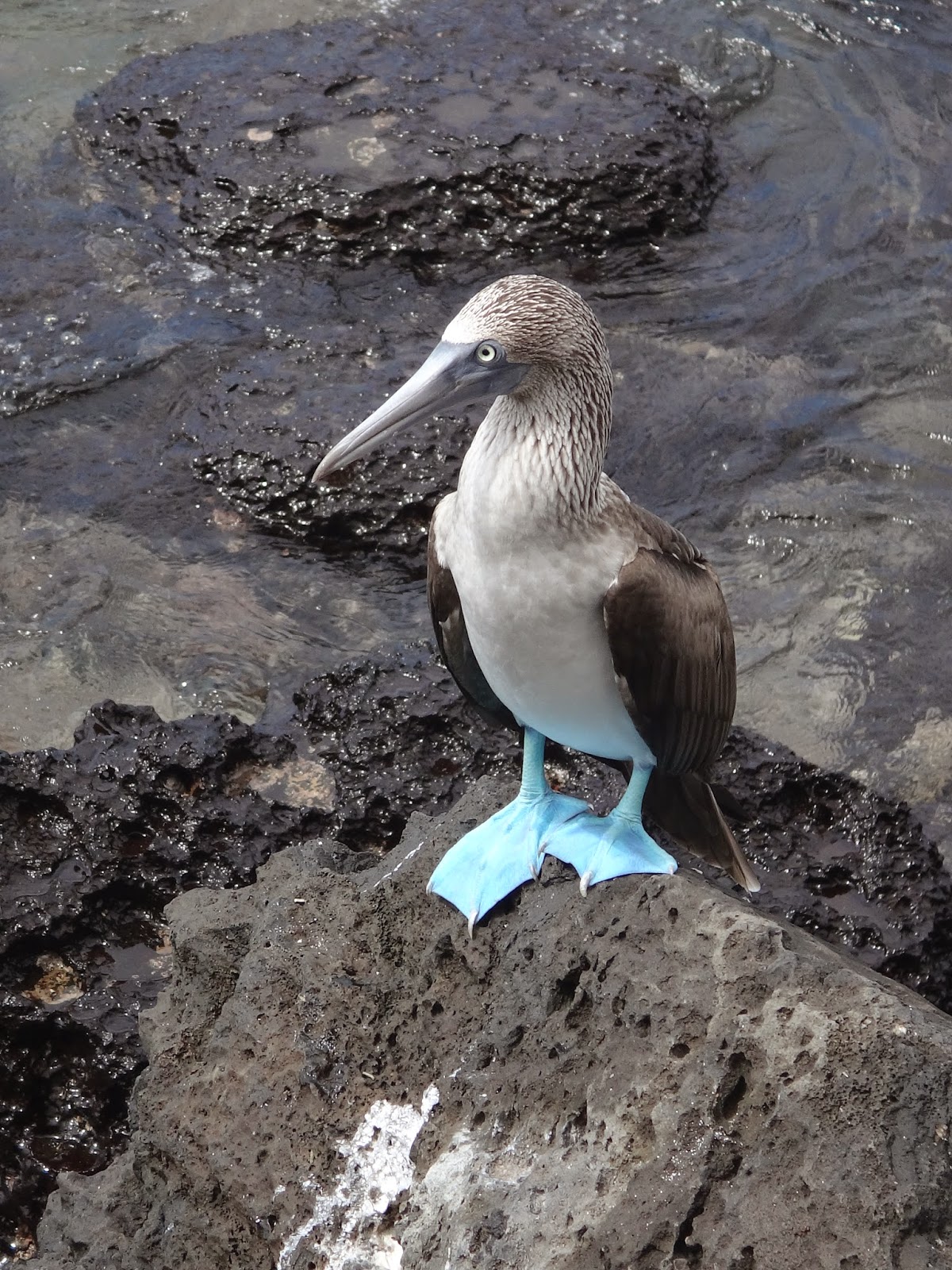
Blue footed Booby

Giant Tortoise

Admiral and Captain of Maggie!

Maggie at Puerto Baquerizo Moreno harbour

Town of Puerto Baquerizo Moreno
 San Cristobol Island, Galapagos

March 1, 2015

Today, Sunday, Rob, Bob and Barb and a few other boaters went on a day long diving/snorkeling excursion to Kicker Rock. Both the diving and snorkellng are supposed to be very good there. I'm waiting to go on a shorter one.

On Sat we took an island tour with an English speaking naturalist guide, a trip well worth the money. The highlight was a visit to Galapaguera, which is the turtle breeding centre on this island. There are 2 more, on Santa Cruz and Isabella. What Darwin found so remarkable here was the different species on each island, their characteristics shaped by their particular environment. That is true of the finches as well as the turtles and other animals. The types of animals present are ones whose ancestors could survive days and weeks at sea without food or water. There are currently 10 different species of turtle with 3 that have become extinct.

The turtles in the sanctuary on San Cristobal weigh up to 200kg and average 60 years old. Life expectancy is between 120 and 170 years. These are land turtles that have different habits than the sea turtles. They are fed 3 times a week and given pools of water for cooling and drinking.

After the nesting period, the rangers remove healthy looking eggs and incubate them 160 days. It takes 30 days after hatching for the newborn to dig itself out of its protective coating of mud and feces. They are then placed in pens divided by age. It takes about 5 years for the shell to be hard enough to withstand predators. That is when they would be released into the wild or kept for breeding. The sex cannot be determined until about age 15 and breeding begins at 25. Everything seems to be on a long time frame which makes study difficult. "Genesis", the first turtle raised here is only 8 years old.

Also on the tour was a visit and hike UP to a freshwater lake in a volcano crater. In the "highlands" the weather is much cooler and wetter which felt very refreshing. The plants, of course, flourish here. We visited a nearby town to take in the beautiful farms and some of the local history. The day also included a visit to a beach. Despite the abundance of jellyfish it was beautiful with a great surf and sand.

We have done a long hike from town to the south coast beaches and cliff faces. We saw our second blue footed booby out there as well as meter long iguanas. There is an excellent interpretive centre in town that warrants another visit when we are more rested than that first day.

Last night we had a group dinner in the covered yard of one of the local families. Except for Rob it was a lobster meal. They had arranged for local entertainment, a band of various traditional instruments. It allowed for lots of good visiting and dancing.

While I have been down below writing this I have missed some excitement around Maggie. The boat moored upwind from us has broken free somehow. Thankfully it has not drifted into any boats and some boaters in the harbour and water taxi drivers have managed to get her anchor down before she reached one of the cruise ships. The owners haven't returned yet but I heard the message on VHF to report if it starts to move again.  Updates on all tomorrow.